









“This was the way the world worked. The white man had a want, and to sate it brown men gave up their lives.”
At first glance, Deepa Anappara’s The Last of Earth is a meticulously researched historical novel, critiquing the imperial project of expansion at the cost of native lives. Set in the politically fraught years of the Great Game, the period of intense rivalry between Britain and Russia over control of Central Asia, it traces the journeys of two sets of travellers, navigating the Himalayas in 1869, to get to Tibet, the Forbidden Kingdom, the legendary meeting place of heaven and earth. Balram, a schoolteacher in a small hamlet in the northern hills, trained in the role of a geographical surveyor, leads an expedition to study the Tsangpo in Tibet.
While Balram’s men face increasingly escalating challenges in a landscape that resists intrusion, Katherine Westcott, a 50-year-old woman traveller, is attempting a quest of her own – to get to the city of Lhasa and see the fabled Potala Palace, breaking a few gender stereotypes along the way. Tibet, its terrain, its unique positioning in history, its defiance of the imperatives of coloniality, and the quotidian rhythms of its people, becomes the canvas that brings these two strands of the narrative together. What is obviously a story of colonial greed bolstered by the desire for personal glory turns into a reflection on grief, loss, and the fragility of hope.
Travels in Tibet
Drawing on survey records, memoirs, and travel writing, the novel reads like a reclamation of subaltern history, telling stories that never made it to official annals. By 1792, Tibet had closed its borders to Europeans, protecting itself from the fate of Sikkim and Bhutan which had already fallen prey to the imperial expansion of Britain. To safeguard its interests in India and prevent Russian ingress via Tibet, Britain was keen on studying – and controlling – Tibetan geography. The Great Trigonometrical Survey of India was already mapping the subcontinent meticulously. In 1861, it decided to use “Asiatic” men as surveyors in Central Asia. With rudimentary training in cartography, often using their own bodies as instruments, Indian men were sent into Tibet in the guise of pilgrims and traders.
The novel begins with one such ill-fated expedition, initiated by the deputy superintendent of the Great Trigonometrical Survey, modelled, seemingly, on Captain TG Montgomerie, who, like his fictional counterpart, was a British officer in charge of all trans-Himalayan survey parties. Dressed in the robes of a priest, wearing brownface, attempting to pass off as a native, the captain insists on joining the expedition at significant risk to his life and that of his crew, all of whom would be punished for the transgression of bringing a white man into Tibet. His surveyor, Balram, heads a team of twelve bearers and two shepherds, hired to plot the course of the Tachok Tsangpo, the Horse River, to figure out if it was the source of the Brahmaputra. Balram, skilled at reading the land, has his own agenda – finding his friend Gyan, who had gone missing on a similar expedition three years ago. From serving the cause of the Crown to using the resources of the Survey for his own purposes, Anappara flips the narrative of the loyal, submissive native, complicit in his own oppression.
In Katherine Westcott, the reader is introduced to the rare category of a female explorer in the 19th century, far removed from the narratives of adventure and masculine bravado that were typical of male European explorers, writing their exploits of conquering the unknown for an adoring public back home. Katherine’s writing career began with the publication of her letters to her sister in England, written during her travels through India. Different from her sister in the colour of her skin, Katherine is never allowed to forget the unfordable chasm that exists between them. Brought to England by her father in early childhood, Katherine remains a stranger to her “mother”, the white woman forced to accept her husband’s infidelity and his “half-caste” child. Keen on forging a legacy of her own, Katherine wants to publish her memoir of travelling to Lhasa.
If Balram intends to game the system for an act of rescue, Katherine will write what sells to her European audience. The freedom of mountain women that she notes with admiration in the trading post of Garbyang is narrated to her readers with manufactured moral outrage: “I was struck by the number of women smoking tobacco outside their houses. If a passing young man caught their fancy, they did not hesitate to hoist their skirts above their ankles and kick a stone in his direction. They see themselves as equal to men, a sentiment I wish I saw more among the ladies of England. I believe this laxity in moral code is a result of Tibetan influence.” Katherine’s voice, then, becomes a tongue-in-cheek critique of the western, orientalising gaze, coding the colonised lands and people with their own inviolable rules. Driven by ambition and haunted by guilt, she forms an interesting counterpoint to Balram, as desirous of making it into Tibet as he is, as haunted by the past as he is.
Telling history
Like Anappara’s 2020 debut novel, Djinn Patrol on the Purple Line, the subtext of this novel remains radically political. If Djinn Patrol turned a cold, wry eye on urban spaces, class disparity and haunting criminality, The Last of the Earth forces the reader to engage (among other things) with the subversiveness of desire. Balram has grown up with Gyan and the two are best friends so well matched, they measure the earth in the exact same unit, each pace being thirty-one-and-a-half inches. The quiet intimacy between the two men, the words that remain unspoken, furtive touches that go unacknowledged, all signal what Lord Alfred Douglas termed “the love that dare not speak its name” in his 1894 poem, “Two Loves”. There is no vocabulary for queer love in Balram’s world and yet, queer desire claims its space in his story, becoming the catalyst for his doomed foray into Tibet. There is no space for queer love in the homes of young men, especially since the coloniser foisted his own law upon them, the narrative reminds us, repeatedly. Anomalous love can only exist within the amorphousness of borderlands and liminal spaces.
With Katherine, the novel dismantles yet another trope of conventional romance by writing within itself the desire of an older, white woman for a younger, “native” man, a rebel who threatens the certainties of the Empire. Katherine runs into the enigmatic Chetak in a cinematic setting, at a waterfall, sparking a series of chance encounters tinged with both annoyance and yearning. With many a dry chuckle, Anappara cocks a snook at romantic anticipation and, more importantly, the power dynamic inherent in race relations between the coloniser and the colonised.
As much as the novel belongs to Balram and Katherine and the stories that unfold around them, it also belongs to Tibet, to the land itself. Balram realises early in the course of their journey that the land resists the chronicling his men intend to do. For Katherine, as she makes her way through mountain passes and deserts and small towns, the landscape turns hallucinatory. Both Balram and Katherine sense a snow leopard, a jatpo, whether spectral or corporeal, stalking them, reducing them to prey, narrowly evading a predator. There is a stark cultural dissonance between the reverence Tibetans have for the Tsangpo, seeing it as their mother and father, and the captain who wishes only to study it and break it down into component parts. The implication is obvious. Like Balram and Katherine, we, the readers, are outsiders looking in and see only what the land chooses to show us. The viciousness of the colonial project, its desire to conquer and assimilate and homogenise, stands bare when Balram challenges colonial cartography:
All the journeys he and Gyan had undertaken to chart rivers and mountains so that the captain could fill the blank space that was Tibet on his map- what purpose had they served? (…) the lines the captain drew on paper appeared to Balram to be no more than a child’s scribbles on mud. If the earth shrugged, mountains would cleave, rivers would surge, seas would swallow cities and fields alike, and every map would be rendered incoherent.
In its astute observations and through its conflicted, troubled cast, The Last of Earth excavates the faultlines of history to find within them stories of those whose labour was dismissed and whose names remain shrouded in mystery. It also shows, in a way fiction seems to be doing more in more, particularly in these times of erasures and elisions, how to tell history better.
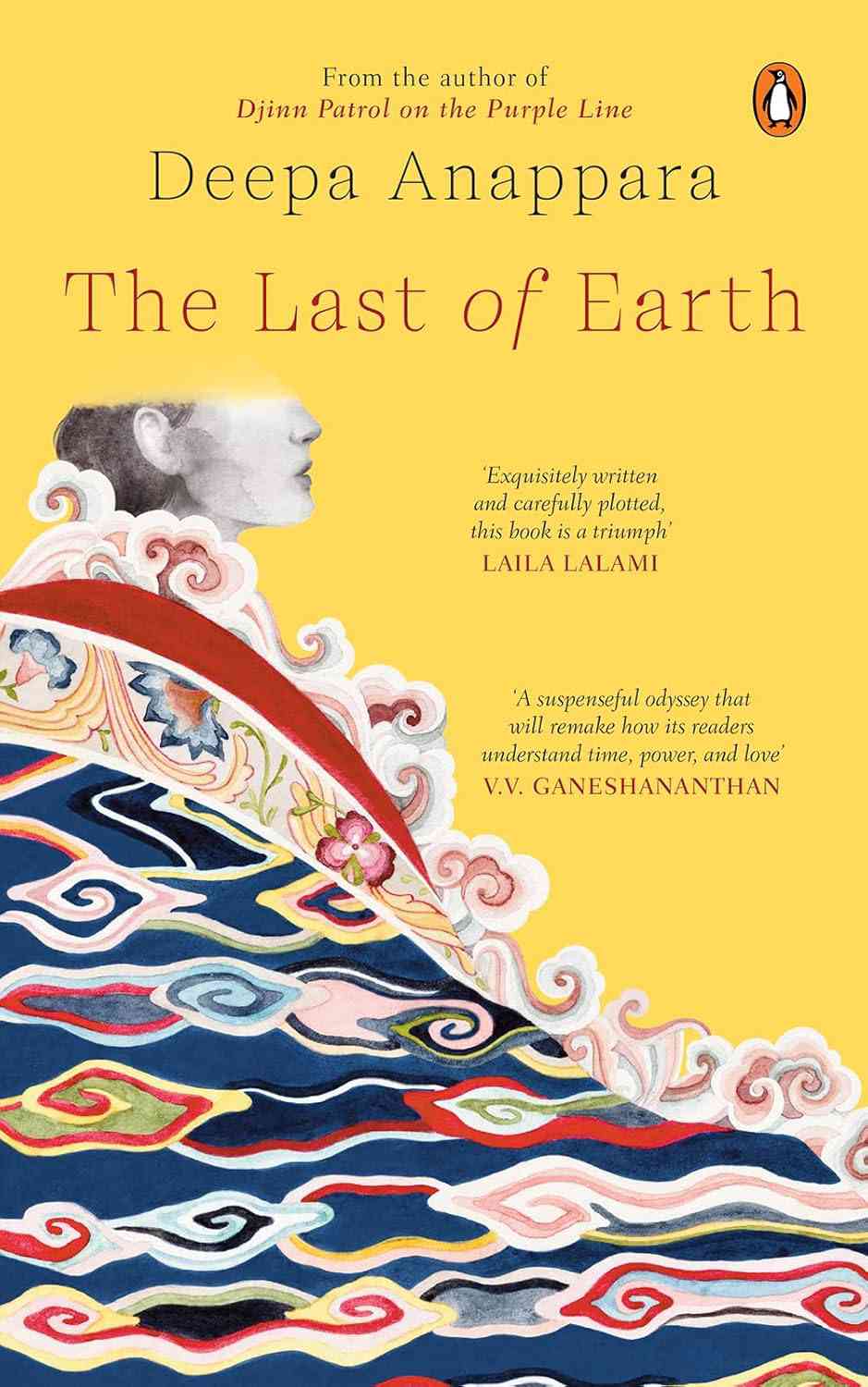
The Last of Earth, Deepa Anappara, Penguin Random House India.
